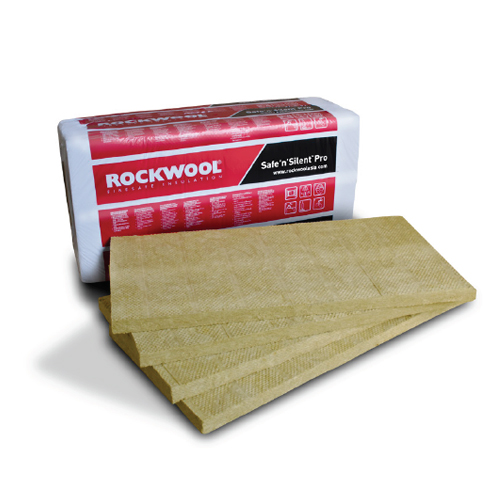
Distinctive properties of ROCKWOOL volcanic stone insulation
Thermal performance and durability
All ROCKWOOL stone wool insulation is made from rock, which is naturally durable and remains stable throughout the service life of a building. This means there is no need to replace the insulation during its lifetime.
The unique physical structure of ROCKWOOL insulation lets it hold its shape and remain durable, unaffected by changes in temperature or humidity. ROCKWOOL insulation has high dimensional stability, which enables it to perform effectively for decades.
ROCKWOOL insulation products also offer excellent thermal performance, thanks to the tiny air pockets in the structure of the stone wool. These help the insulation keep heat outside in hot climates and retain warmth inside in cold regions.
These factors allow you to maintain a comfortable temperature all year round and save energy and the costs of cooling/heat dissipation.
ROCKWOOL insulation can be used under the most severe conditions, as it retains its insulating properties at very low temperatures (for example in oxygen installations) and at temperatures as high as 1000 °C.
Fire safety
ROCKWOOL’s fire safety stems from the high-temperature fire behavior of its fibers, which helps reduce the effects of a fire:
1. ROCKWOOL insulation helps stop fire from spreading. Its fire protection properties prevent buildings or other fire-sensitive materials from igniting.
2. It adds a building structure component that helps prevent fires.
3. It is not a fuel and does not cause flames to spread.
ROCKWOOL insulation enhances the safety of occupants and rescue personnel, as well as protecting property and valuables, raising safety and improving the effectiveness of fire protection.
Fire protection
Non-combustible ROCKWOOL insulation acts like a firewall and does not cause flames to spread. The level of protection can be increased in combination with smoke detectors, alarms and automatic sprinkler systems.
ROCKWOOL insulation is classified as a non-combustible material.
ROCKWOOL insulation is classified as Euroclass A1 and A2 under EN 13501-1, the standard on reaction-to-fire classification. ROCKWOOL insulation has also been classified in these categories for international reaction-to-fire tests, an evaluation outside the European Union system.
Euroclass A1 classification confirms that ROCKWOOL insulation does not contribute to flames in the non-combustibility test. In A1 products containing organic components, the energy released is very strictly limited.
A2 classification confirms that ROCKWOOL insulation does not produce flames for longer than 20 seconds in the non-combustibility test. A2 products must meet strict requirements regarding fire, severe combustion and the Burning Droplet Test.
Therefore, in addition to selecting insulation products for their thermal and acoustic properties, an insulation’s resistance to high temperatures and its ability to help inhibit the spread of fire are important considerations for architects, builders and building owners.
Excellent acoustic properties
ROCKWOOL insulation is classified among the most widely used and most effective sound insulation products for construction work.
It is not only the thermal insulation property of stone, a science that is difficult to research and develop; ROCKWOOL insulation is also regarded as the most effective product for acoustic insulation used in construction.
Installing ROCKWOOL thermal insulation helps reduce noise from outside, from neighbors, or internal noise between floors and rooms. Our product specialists can help you design an acoustic environment suited to each area’s use, whether a school hall, a concert venue or rooms in a new home.
The air spaces between the stone wool fibers give ROCKWOOL insulation good sound absorption and help reduce sound-induced vibration. ROCKWOOL insulation can be used in ceilings, soundproofing, around noisy machinery, in external walls, between rooms, and in roofs and floors to reduce noise and vibration and to improve comfort.
Health
ROCKWOOL insulation is made of fibers that are brittle. When the material is cut with sharp tools such as a sharp knife or saw, the insulation does not generate dust from cutting.
ROCKWOOL insulation is safe to work with. Based on testing, this stone wool insulation does not cause cancer. This is supported by the decision of the International Agency for Research on Cancer (IARC), the World Health Organization’s cancer research agency, to remove stone wool from its list of “possible carcinogens”. The conclusion is based on epidemiological studies that showed no evidence of increased lung cancer risk from exposure to stone wool fibers, and no tumors were found in long-term inhalation studies in laboratory animals. By similar factors, there is also no evidence of an increased risk of pulmonary fibrosis.
Low-emission building material
Comprehensive emissions research on stone wool insulation at the Fraunhofer Institute in Braunschweig showed that stone wool is not a source of formaldehyde in the environment or inside buildings, so there is no need for concern among people living in homes fitted with this thermal insulation. In addition, testing under the Finnish Emission Classification for ROCKWOOL insulation products, covering emissions of formaldehyde and volatile organic compounds, classified ROCKWOOL insulation as M1 (best quality), “building materials with low emission levels”.
Information referenced from http://www.rockwool.co.th